
In a competitive market, the offer with the highest price often wins, but not always in the way buyers expect. An escalation clause is one of the tools buyers use to stay competitive without automatically overpaying, and in many markets it has become a standard part of how serious offers are written. Knowing when to use one, how to structure it, and when to leave it out entirely can be the difference between winning the home you want and losing it over a number you would have been comfortable paying. It is also where having the right strategy, financing, and guidance all working together starts to matter.
What an Escalation Clause Actually Does
An escalation clause is a written addition to a purchase offer that allows your bid to increase automatically if another buyer submits a higher competing offer. Instead of choosing one number and hoping it holds, you are setting clear rules for how far you are willing to go.
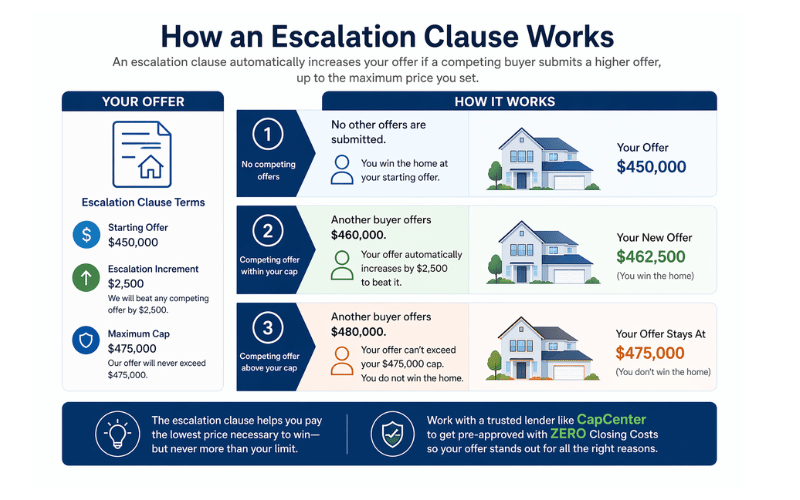
Every escalation clause is built on three parts. The first is your starting offer, which is the price you are offering if no one else competes. The second is the escalation increment, which is how much you are willing to outbid another offer by. The third is your cap, which is the maximum price you are willing to pay, no matter what happens.
A simple example makes this clear. You might submit an offer at $450,000 with an agreement to beat any competing offer by $2,500, capped at $475,000. If another buyer comes in at $460,000, your offer automatically moves to $462,500. If someone offers $480,000, your offer stays at your $475,000 cap and you are out.
This is how many competitive offers are structured today, especially when buyers are working with experienced agents and lenders who understand how these clauses are actually evaluated. The real advantage is not just that your offer can adjust. It is that you are letting the market determine the price within boundaries you have already decided are reasonable.
Why Buyers Use Escalation Clauses
Real estate offers are often submitted without knowing what anyone else is doing. That uncertainty is where most buyers struggle. Some come in too low and miss out. Others go too high and later realize they paid more than they needed to.
An escalation clause helps reduce that gap.
If you offer $465,000 outright and the next highest offer was $445,000, you likely paid significantly more than necessary. If you offer $445,000 and the winning offer was $455,000, you lost over a difference that probably would not have changed your decision. An escalation clause allows you to compete within that range instead of guessing blindly.
This is also where preparation starts to separate buyers. At CapCenter, this is one of the areas we focus on upfront. It is not just about what you are approved for. It is about understanding how to position your offer so you can compete confidently without stretching further than you need to.
There is also a signaling effect that matters more than most buyers realize. When a seller reviews multiple offers, they are not just comparing price. They are trying to understand which buyers are serious and which ones are stretching. A well-structured escalation clause shows that you have thought through your numbers and are prepared to compete, but not without limits.
When an Escalation Clause Makes Sense
Escalation clauses are most effective in situations where competition is expected, not assumed.
The clearest example is a well-priced home that is likely to attract multiple offers within the first few days on the market. These are the listings where buyers tend to cluster, and where a strong but flexible offer can make the difference. In those situations, starting at a reasonable price and allowing your offer to move as needed can keep you competitive without forcing you to lead with your absolute maximum.
They also make sense when you already have a clear ceiling. If you know you are not willing to go above a certain number, an escalation clause lets you compete up to that point without committing to it immediately. That is a more disciplined approach than simply offering your max and hoping it holds.
One practical detail that often gets overlooked is whether the listing agent will even accept escalation clauses. Some do not. In those cases, including one does not strengthen your offer, it complicates it. This is where working with an experienced agent matters. CapCenter Realty agents handle these conversations regularly and can usually confirm how a listing agent prefers to handle offers before you ever submit one.
When to Skip It
There are just as many situations where an escalation clause works against you.
If there are no competing offers, the clause has nothing to act on. What it does do is reveal your ceiling. A seller who sees that you are willing to go up to $475,000 now has a clear target, even if your initial offer was $450,000. In that scenario, a clean, well-structured offer is usually stronger than one that shows your full range.
Escalation clauses are also less useful in slower markets. When homes are sitting longer and price reductions are common, the dynamic shifts. You are no longer trying to outmaneuver multiple buyers. You are negotiating directly with a seller, and the strategy changes with that.
There are also sellers who simply will not entertain escalation clauses at all. In those cases, you are better off submitting your strongest offer upfront rather than relying on a mechanism that will be ignored or rejected.
How to Structure an Escalation Clause
The effectiveness of an escalation clause comes down to how it is written. Small decisions here can have a real impact on how your offer is received.
Your starting price still needs to stand on its own. If it comes in well below the list price, it can signal that you are relying entirely on the escalation to carry your offer. In most competitive situations, your starting point should already be in line with where the home is expected to trade.
The increment should feel meaningful without being excessive. In many markets, that means a few thousand dollars at a time. Too small, and it can feel like you are not taking the competition seriously. Too large, and you risk jumping further than necessary in a single step.
The cap is where most of the discipline comes in. This is not just a number. It is a decision. It should reflect what the home is worth to you, what comparable sales support, and what your financing comfortably allows. This is another place where having a clear understanding of your numbers ahead of time matters. Buyers who have already worked through different pricing scenarios with their lender tend to make stronger, more confident decisions here.
One important safeguard is requiring proof of the competing offer. Without that, there is nothing preventing a seller from claiming a higher bid exists. A properly written clause should require documentation, typically a redacted copy of the competing contract, before your offer escalates.
The Risks Buyers Overlook
Escalation clauses can be effective, but they are not without tradeoffs.
The first is appraisal risk. If your offer escalates beyond what the home appraises for, your lender will base the loan on the appraised value, not the contract price. That gap has to be covered in cash, renegotiated, or it becomes a deal that falls apart. This becomes even more important if you are considering waiving an appraisal contingency, which is a separate decision entirely and one that should be made carefully.
There is also the reality that you are showing your hand. Once your cap is on paper, the seller knows exactly how far you are willing to go. In some cases, that information can be used against you in a counteroffer.
The third risk is less technical and more personal. It is easy to let emotion influence the cap, especially in a competitive situation. That is how buyers end up stretching beyond what makes sense for them long term. The clause does not prevent that. It only enforces the number you choose.
How Financing Fits Into the Equation
An escalation clause is only as strong as the financing behind it. Sellers are not just choosing a price. They are choosing the offer that feels most likely to close.
That is why a strong pre-approval matters. A buyer who has already gone through a deeper level of underwriting presents far less risk than someone with a basic pre-qualification. In competitive situations, that difference is often just as important as the price itself.
This is also where the structure of your loan can quietly change how competitive you can be. With CapCenter’s ZERO Closing Costs mortgage, buyers are not setting aside a separate portion of their cash for closing expenses. That changes how far their budget can stretch.
Instead of dividing funds between down payment and closing costs, that same cash can be applied more directly where it matters in a competitive offer. It can support a stronger price, help cover a potential appraisal gap, or simply give you more confidence when setting your cap. It is one of the practical ways the savings show up before you close, not just after.
If you want to see how different purchase prices fit into your budget, CapCenter publishes current mortgage rates daily and provides a mortgage calculator that lets you run those numbers before you ever submit an offer.
What Sellers Actually Think About Escalation Clauses
From the seller’s side, escalation clauses tend to fall into two camps.
Some sellers appreciate them because they make it easier to identify which buyers are willing to compete and how far they are willing to go. In a multiple-offer situation, that can simplify the decision.
Others find them frustrating. They introduce an extra layer of verification, require documentation, and can make comparing offers less straightforward. In some cases, sellers prefer to ask for highest and best offers instead of working through escalation clauses at all.
The experience of the listing agent often shapes how these are handled. An agent who deals with them regularly knows how to verify offers and move the process forward cleanly. An agent who does not may steer the seller away from them entirely.
That is where experience on your side matters as well. CapCenter Realty agents rank in the top 1% by transaction volume in the markets they serve, which means they have seen these situations play out in real time. That experience shows up in how offers are structured, how escalation clauses are used, and how negotiations are handled when multiple buyers are involved.
The Bottom Line
An escalation clause is not a strategy on its own. It is a tool that works when it is used deliberately.
It makes sense in competitive situations where multiple offers are likely, when you have a clear ceiling, and when your financing supports the offer you are making. It becomes less effective when used automatically, without a defined limit, or in markets where the leverage has shifted toward buyers.
The buyers who use escalation clauses well are not trying to outguess the market. They are setting boundaries ahead of time and letting the process play out within those boundaries. They understand what they are willing to pay, they have their financing in place, and they work with a team that knows how these offers are actually received on the other side.
If you are preparing to make an offer, the most important step is not the clause itself. It is making sure everything behind it is solid. With CapCenter, you can get pre-approved, understand your numbers clearly, and work with a team that handles both the financing and the realty side together, which makes the entire process more straightforward from the start.